Two majestic waterways characterize the Saguenay–Lac-Saint-Jean region: the Saguenay Fjord, the only inhabited fjord in North America, and Lac Saint-Jean, a true inland sea. In our region, water and cycling go hand in hand. Several marine shuttle options are conveniently available along the length of the course.
Lac-St-Jean
Le Maligneau, Alma
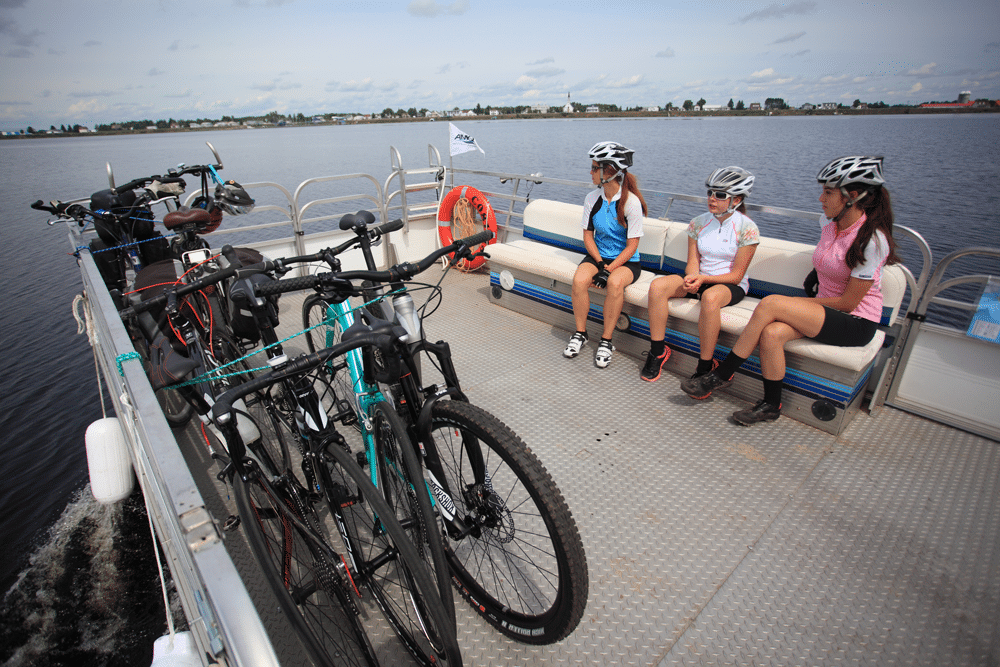
Accessible via the Dam-en-Terre Resort and Avenue du Pont Nord, close to Odyssée des Bâtisseurs. Crossing the Rivière Grande Décharge takes about five minutes and is free of charge for all cyclists.* No reservation required.
More : Véloroute des Bleuets
Pointe-Taillon shuttle-taxi, Péribonka
This ferry gives access to the Parc national de la Pointe-Taillon and to the Pointe-Chevrette and Île Boulianne campgrounds. It operates from June to September. The 2.5 km crossing takes about 10 minutes and is fee-charging.
Please note, our schedule is weather dependant. As such, last-minute changes may occur in the event of adverse weather conditions.
Information: 418-374-2967 # 201 ou # 103 / 1 888-374-2967
Schedule and infos
Saguenay
Les Navettes maritimes du Fjord
Travel with your bicycle between the Saguenay Fjord’s villages and cities with the Navettes maritimes du Fjord, a division of Promotion Saguenay. Similar to a taxi-boat, the shuttle is ideal for seeing the fjord’s interior sections and avoiding steep roads along the Véloroute du Fjord du Saguenay. Luggage transportation is also available.
Wharf of boarding:
- La Baie
- Sainte-Rose-du-Nord
- Rivière-Éternité (Parc national du Fjord-du-Saguenay)
- L’Anse-Saint-Jean
Information : 418-543-7630 / 1 800-363-7248
www.destination.saguenay.ca
Jonquière to Shipshaw ferry
Shuttle service for cyclists and pedestrians enabling passage across Rivière Saguenay between Jonquière and Shipshaw. Pontoon boat crossing, duration of about 10 minutes. Capacity: 12 passengers and 12 bicycles.
Operating at the beginning of June.
- Free. No reservation needed.
- Time : 10 minutes
General information : 418 698-3200 poste 4164
Information | Docks & Marina : Jean-François Potvin 418 550-4848
Information | Bicycle crossing : 418 698-3000 poste 4165 or [email protected]
Service may be interrupted on certain days due to winds and river currents.
Electric bikes: For safety reasons, you must turn off the electric assist on your bike’s controller before boarding, and keep it off until after disembarking on the opposite shore.

Plan
your experience